
Your Thai Landlord's Lease Might Not Be Legal: What Every Tenant Needs to Know
You found the apartment. You paid the deposit. You signed the contract. But what if the document you signed was copied from a stationery shop, downloaded from a 2009 template, or simply made up by someone who has never spoken to a lawyer in their life? In Thailand, this is not the exception. It is the norm. And the clauses in that lease, the ones that say your landlord can keep your entire deposit, enter without notice, or charge whatever they like for electricity, may be completely unenforceable under Thai law. The question is whether you know that before something goes wrong.
Disclaimer: Lease Shield is not a law firm and does not provide legal advice. All content is for informational purposes only. Consult a qualified Thai property lawyer for legal matters.
Quick Facts: Thai Rental Leases in 2026
- • Most Thai landlords: Individual investors, not professional operators
- • Bangkok condo vacancy rate: Approximately 24.8% (426,000 empty units)
- • Law governing leases: Civil and Commercial Code Sections 537 to 571
- • 2025 regulation applies to: Landlords with 3 or more residential units
- • Illegal clause penalty: Up to THB 200,000 per violation
- • Prohibited terms: Automatic deposit forfeiture, utility markups, no-notice entry, no termination rights
- • Deposit return deadline: 7 to 14 days under 2025 law (not 30 days)
- • Cost of professional lease review: From THB 10,000
Why Most Thai Landlords Are Not Property Professionals
Thailand's rental market is built on a model that almost guarantees amateur landlords. Developers build high-rise condo projects and sell individual units to separate buyers, mostly middle-class Thais and foreign investors who purchased one or two units as income properties. These are not property businesses. They are individuals who bought a second asset, listed it on Facebook or other platforms, and now manage it informally through LINE messages.
Bangkok's condo vacancy rate sits at approximately 24.8%, with around 426,000 empty units across the metro area. Most of these belong to individual investors, not developers. In Pattaya, years of speculative foreign buying, particularly from Chinese and Russian investors who purchased blocks of new units, has left many properties managed from overseas by absentee owners. In Chiang Mai, the market is even more informal, driven by digital nomads and retirees, with property finding happening through Facebook groups and terms negotiated over LINE.
The result is a rental market where professional property management is the exception, not the rule. And where self-management is the norm, self-drafted leases follow.
"Bangkok has approximately 426,000 vacant condo units, most owned by individual investors managing their own rentals without professional support."
What a Legally Valid Thai Lease Must Contain
Thai rental law sits primarily in the Civil and Commercial Code (CCC), Sections 537 to 571. A valid lease requires an agreement granting use of property for a limited time in exchange for rent. For leases of three years or less, no registration is required but a written agreement is strongly advisable. For leases exceeding three years, registration at the Land Department is mandatory, without it, the lease is only enforceable for three years regardless of what the contract says.
One provision that catches many tenants by surprise: under Section 561, if there is no written condition report at move-in, the tenant is legally presumed to have received the property in good repair and must return it in the same condition. This single missing document can cost you your entire deposit.
The 2025 Consumer Protection Board Notification (effective 4 September 2025) added a further layer of mandatory protections for qualifying tenancies. For landlords operating three or more residential units, a range of terms are now either automatically required or automatically prohibited, regardless of what the lease document says.
Thailand's New Rental Law 2025: What Changed and What It Means for You
Clauses in Your Lease That Are Probably Unenforceable
Amateur leases in Thailand follow predictable patterns. The clauses that appear most often in stationery-shop contracts and copied templates are also, frequently, the ones that either violate the 2025 notification or would not survive court scrutiny.
Automatic Forfeiture of the Entire Deposit
Any clause stating that the landlord may keep the full deposit if the tenant breaks the lease, causes any damage, or leaves early is unenforceable as written. Deposits can only be used to offset unpaid rent, proven damage beyond normal wear and tear, or documented repair costs. Blanket forfeiture with no justification is prohibited.
Landlord Entry Without Notice
The 2025 notification explicitly prohibits landlords from entering the property without prior notice, confiscating belongings, or conducting non-emergency inspections without the tenant's knowledge. Any lease clause granting unannounced access is void.
Utility Charges Above Government Rates
One of the most widely reported complaints in Thailand's expat community is electricity and water overcharging. Forum posts document cases where landlords charged 7 to 10 baht per unit for electricity, the government rate is approximately 3.99 to 5 baht per unit. Under the 2025 law, markups above the official government tariff are explicitly prohibited for landlords with three or more units. A clause in your lease setting a higher rate is unenforceable.
No Termination Notice Required
Any clause allowing a landlord to terminate the tenancy without notice is unlawful. The 2025 notification requires a minimum of 30 days written notice before termination, with exceptions only for urgent misconduct (7 days) or situations involving public order.
Tenant Liability for Normal Wear and Tear
Paint fading, small nail holes, minor scuffs, carpet compression from furniture, these are normal wear and tear and cannot be charged to the tenant under Thai law. Any clause attempting to hold tenants liable for ordinary deterioration from reasonable use is unenforceable.
"Under Section 35 quater of the Consumer Protection Act, any prohibited clause in a covered lease is deemed nonexistent, it disappears from the contract entirely, regardless of whether you signed it."
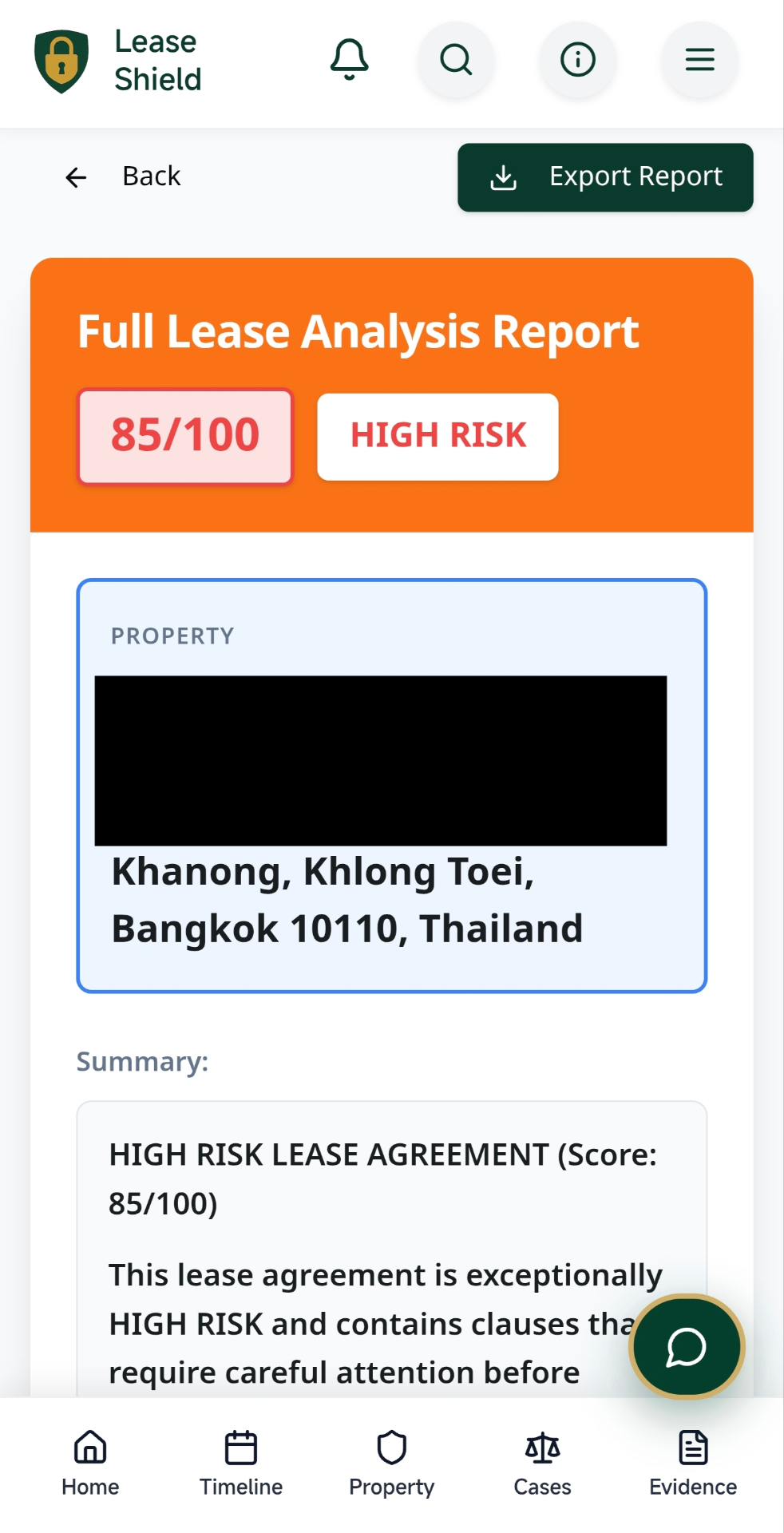
A real Lease Shield scan result showing a Bangkok condo lease rated 85/100, HIGH RISK, with clauses flagged for urgent attention before signing.
How to Spot a Lease That Was Never Near a Lawyer
The differences between a professionally drafted lease and a copied template are visible before you read a single clause.
Signs of a professional lease:
- Runs 5 to 15 pages with attached annexes
- Written in bilingual format (Thai and English in parallel columns)
- References the Civil and Commercial Code by section number
- References the 2025 Consumer Protection Board Notification
- Includes a signed move-in condition report with photo inventory
- Specifies utility rates at government levels
- Contains a severability clause
Signs of an amateur or copied lease:
- One to two pages with generic boilerplate
- Thai only, with no English translation
- References to "state law" or "fair housing" with no Thai legal equivalent
- Placeholder text left unfilled
- No chanote or Land Department reference number
- No condition report or inventory attached
- No termination procedure beyond vague language
A Thai-only document is particularly dangerous for English-speaking tenants. Signing a document you cannot read creates real legal exposure, even if you believe the verbal summary you were given.
Before You Sign: The Expat's Due Diligence Guide for Renting in Thailand
What the 2025 Law Means If Your Lease Is Bad
This is where the 2025 Consumer Protection Board Notification works strongly in your favour, if your landlord operates three or more units.
Under Section 35 ter of the Consumer Protection Act, if a mandatory protection is missing from your lease, it is automatically deemed incorporated as an implied term. You do not need it written in the contract to benefit from it.
Under Section 35 quarter, any prohibited clause is deemed nonexistent and unenforceable, regardless of your signature.
This means that even a badly drafted, copied, or incomplete lease cannot strip you of your statutory rights if you fall within the scope of the 2025 notification. The law fills the gaps and removes the illegal terms.
The critical question is always: does your landlord operate three or more residential units? If you are renting from a private individual with a single property, the stronger protections of the 2025 notification do not apply, and you rely more heavily on the Civil and Commercial Code's basic provisions and general principles of unfair contract terms.
Scan your lease to identify which clauses may be unenforceable before you sign
What Happens When Things Go Wrong
Deposit disputes are Thailand's most documented rental conflict. Forum discussions across expat communities paint a consistent picture: landlords who never intended to return deposits in full, agents who lack both the authority and the incentive to push back, and tenants who realise too late that the clause they thought protected them was unenforceable from the start.
Documented patterns include:
- Full deposit retention with no itemised justification
- Utility overcharging sustained throughout the tenancy by a lease clause that was always illegal
- Damage claims for normal wear and tear, backed by a lease that explicitly, but unlawfully, made tenants liable
- Illegal lockouts when tenants disputed charges, despite Criminal Code Section 365 making this a criminal offence
Recourse options exist. The OCPB accepts consumer complaints online, small claims court handles disputes under THB 300,000 with a THB 200 filing fee, and consumer cases are exempt from court fees. Class-action cases have succeeded in recovering individual amounts of approximately THB 20,000 per claimant. But these routes require time, Thai-language proceedings, and documentation you may not have if you did not document your tenancy from day one.
A professional demand letter citing the relevant law, sent before any case is filed, resolves many disputes without ever reaching court.
Lease Shield Resolve provides professional demand letters in Thai and English
What to Do When a Tenant Stops Paying Rent: the landlord perspective
How to Protect Yourself Before You Sign
- Scan the lease before signing. Upload it and get a full risk analysis identifying flagged clauses, their severity, and recommended actions. A score of 61 or above signals high risk, clauses worth negotiating or refusing outright. Lease Shield lease scan scans both Thai and English language leases. Scan your lease with Lease Shield
- Ask for a bilingual version. If the landlord only provides Thai, request an English translation. A landlord who refuses is a red flag in itself.
- Insist on a signed move-in condition report. Photograph and video every room, wall, appliance, and fixture on arrival. Have the landlord or agent acknowledge the condition in writing. Store your move-in evidence securely in the Evidence Vault
- Verify whether the 2025 notification applies. Ask directly how many units the landlord manages. If three or more, your stronger statutory protections are in force, and any clause violating them is void.
- Track your deposit return deadline. Under the 2025 law, you are entitled to return within 7 to 14 days of vacating. Set a reminder and follow up in writing. Track your deposit return deadline automatically
How to End a Lease Early in Thailand Without Losing Your Deposit
Frequently Asked Questions
Do Not Sign Until You Know What You Are Signing
Thousands of tenants in Thailand sign rental leases every month that contain clauses their landlord cannot legally enforce. The problem is that by the time the dispute arrives, it is often too late. Lease Shield gives you a complete risk analysis of your lease before you commit, so you know exactly what you are agreeing to, and what you are not.
Scan My Lease NowAlready in a dispute? Lease Shield Resolve provides professional demand letters in Thai and English without expensive lawyers.
Get Dispute SupportRelated Articles
This article is for informational purposes only and does not constitute legal advice. Lease Shield is not a law firm. For legal matters relating to your tenancy, consult a qualified Thai property lawyer.